Scientific due diligence
Test the claims, methods and scientific assumptions behind an investment or partnership before committing.
EVIDENCE SYNTHESIS / SCIENTIFIC RESEARCH CONSULTING
A product claim to check. A science-led investment to assess. A policy briefing that cannot wait. Commission a rapid evidence synthesis that explains what the research supports, what remains uncertain and what that means for your decision.
From €595 excluding VAT. I review every assignment personally. Standard scoped work normally takes 48–72 hours after the scope and inputs are confirmed. Larger programmes follow an agreed schedule.
Aron Bijl, MSc. · Published research on research methods and questionable research practices. Read the papers →
RESEARCH YOU CAN COMMISSION
Test the claims, methods and scientific assumptions behind an investment or partnership before committing.
Need to know what the scientific literature actually supports? Commission a structured evidence review that weighs the studies, explains disagreement and gives you an answer you can trace back to the sources. Not just a folder of papers.
A decision is coming. The evidence is scattered. Commission a rapid evidence synthesis that explains what is supported, what conflicts and what remains unknown—before the deadline, without pretending the shortcuts do not exist.
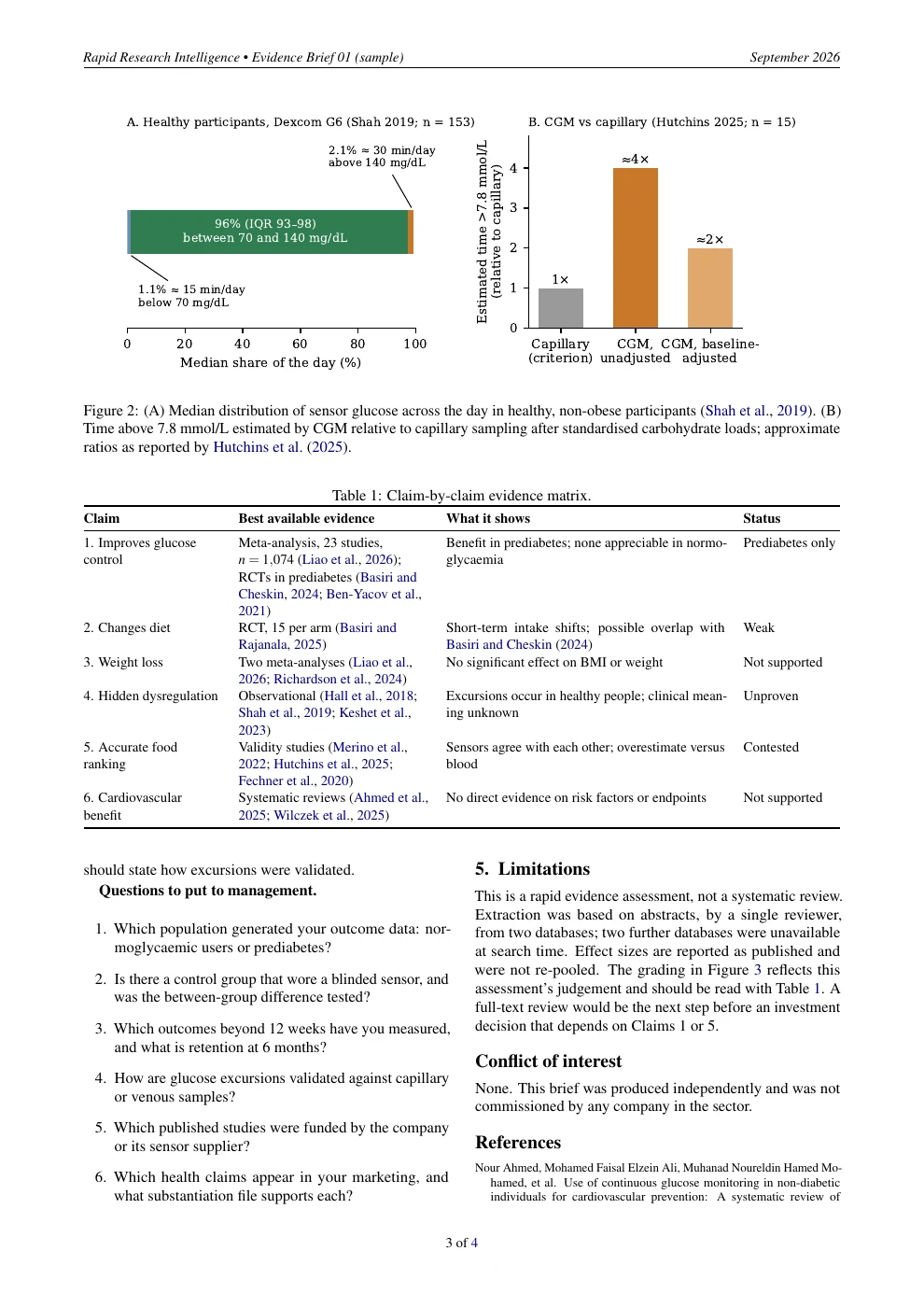 CGM EVIDENCE BRIEF · PAGE 3 OF 4
This sample examines six commercial claims about continuous glucose monitoring in people without diabetes. It shows how I turn a literature search into a brief an investment team can interrogate.
Free PDF · Four pages · No email required. Independently produced sample, not a client commission or a systematic review.
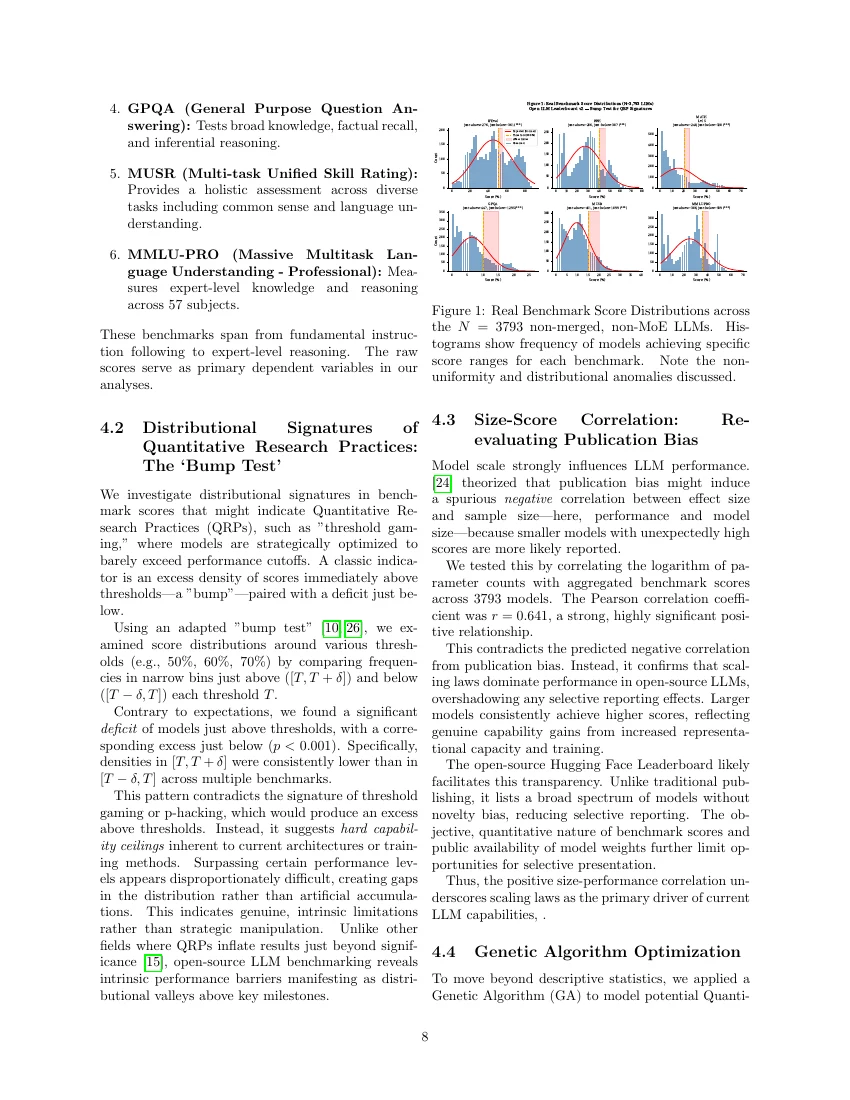
My original research examines 3,793 language models, six benchmarks and the role of questionable research practices. It investigates how evaluation choices and selective reporting can affect the results you see on a leaderboard.
Read the benchmarking paper (PDF)For my peer-reviewed work on research methods, see the publications.
WHEN THE EVIDENCE HAS CONSEQUENCES
01 / Claims & product teams
For supplement, health and cosmetics brands: a claim-by-claim evidence matrix, study limitations and gaps to take to your regulatory adviser.
Discuss this question02 / VC & corporate development
For investment teams assessing a science-led business: a technical due-diligence brief separating demonstrated results, assumptions and unresolved risks.
Discuss this question03 / Policy, NGO & public health
For policy and programme leads: a rapid evidence brief with competing findings, confidence levels and the implications for your decision.
Discuss this question04 / Legal research teams
A source-linked research map that distinguishes association from causal evidence and identifies issues for a qualified expert to assess.
Discuss this question05 / Medtech & regulatory affairs
A focused literature landscape, evidence table and gap analysis to support your team's submission planning and specialist review.
Discuss this questionThese are research-support assignments. Clinical decisions, legal opinions, expert testimony and regulatory sign-off remain with the appropriate qualified professionals.
Bring me the question you need answered and the decision it affects. You receive an agreed evidence brief, analysis or research plan: the findings, their strengths and limitations, and the gaps that matter. I use AI to accelerate the research and check the result against the sources before it reaches you.
Reviewed standard assignments are normally delivered within 48–72 hours after the scope, inputs and Research Equivalent allocation are confirmed. Larger or more complex work follows an agreed schedule.
| Package | Budget | Excl. VAT |
|---|---|---|
| Single Assignment | 1 RE | €595 |
| Sprint | 10 RE | €3,500 |
| Mapper | 25 RE | €8,000 |
| Landscaper | 50 RE | €15,000 |
A Research Equivalent (RE) is a unit of scoped work, not a count of papers. A focused question may take 1 RE; complex material may take more. Client datasets and messy internal material start at 2 RE. Larger packages can span several research cycles, with scope and timing agreed before work begins.
An agreed output in PDF, Word or Markdown: for example, an evidence synthesis, technical landscape, comparison, analysis or research plan. Citations, limitations and uncertainty are made explicit. One revision round for factual corrections or missed context is included.
An Evidence Calibration Review checks source support, overreach, uncertainty, methodological caveats, claim strength and citation traceability. I then review the result for coherence, relevance, scope and practical use.
Use the research brief form to share your decision, question and deadline. We confirm the scope, RE allocation, output and delivery window before work starts. Standard scope uses existing sources and data; it excludes new experiments and primary data collection. Formal systematic reviews, meta-analyses and full manuscript writing need a separate scope. Research support does not replace legal, clinical, regulatory or financial advice. The full offer includes confidentiality and payment terms.
THE RESEARCH PIPELINE
AI accelerates the repetitive parts of literature and document analysis. The question, evidential standard and final judgement remain explicit throughout.
Define the decision, audience, source material, exclusions and useful final format before the search expands.
Search agreed sources, incorporate client material, remove duplication and keep the provenance of each claim visible.
Compare findings, extract relevant data and identify patterns, conflicts, gaps and assumptions that affect the answer.
Review source support, claim strength, methodological caveats, uncertainty and citation traceability.
Produce the agreed evidence synthesis, analysis, decision brief or research plan, followed by one factual correction round.
Depending on the question, the work can include a focused literature review or rapid evidence assessment. Formal systematic reviews and meta-analyses require a separate protocol, scope and timeline.
START WITH THE DECISION
A short brief is enough to start. I’ll review whether the question fits, then confirm scope, price, deliverable and timing with you before work begins.
No purchase or commitment at this stage. Please describe sensitive material in general terms; we can arrange confidential sharing separately.
Focused assignments from €595.
Sprint budget: €3,500 / 10 RE.
Excluding VAT. Package allocations may span several delivery cycles.
How we perceive, decide, and act.
Rigorous scientific methodology in cognitive and behavioural research. Experimental design and the study of human cognition connect my research with the systems I build.
The experience behind the mechanism.
Investigating the fundamental nature of conscious experience and perceptual processes through experimental psychology and neuroscience methodologies.
Could an artificial system have experience?
I also research AI consciousness: whether artificial systems could have subjective experience, how we might recognise it, and what would count as evidence. This connects questions about awareness and cognition with the architectures of the systems we build, and the distinction between convincing behaviour and experience itself.
Invite me to speak about AI consciousnessUnusual questions. Careful methods.
Scientific investigation of anomalous phenomena including telepathy, presentiment, and retrocausal effects. My focus is on experimental methods, statistical interpretation, and what the evidence can support.
Can later practice show up in earlier performance?
Normally, we practise first and perform better afterwards. Retroactive practice is the proposed reverse: an association between practice that happens later and performance already measured. With Dick Bierman, I investigated this using a Go/NoGo task, in which participants respond to certain shapes and withhold their response to others.
In our 2014 paper, the 67 participants analysed had responded about 2% faster to the shape that would later be practised. The strongest statistical evidence came from the 35 participants classified as intuitive thinkers: the results section reports p = 0.001, one-tailed. The rational-thinking group did not show a significant effect.
I see this as strong evidence consistent with retroactive practice in the intuitive group, and a finding worth pursuing. Establishing its robustness calls for independent, preregistered replication. Our paper also examines ambiguities in the original analysis plan and their implications for interpreting the results.
Read the published studyBierman & Bijl (2014), Journal of Scientific Exploration, 28(3), 437–452. Results: pp. 444–445; discussion: pp. 448–451.
Looking for the structures underneath.
Developing theoretical models for fundamental physics, exploring the mathematical structures underlying physical reality and consciousness.
A better way through difficult problems.
Methodologies for navigating complex solution spaces, combining computational approaches with cognitive strategies for effective problem-solving.

A new arrival in problem space optimization.
Human understanding. Machine capability.
Designing effective human–AI interactions and prompt engineering strategies for large language models and autonomous AI systems.
AI & automation services