RESEARCH CONSULTING / WORK WITH ME
Rapid evidence synthesis
A decision is coming. The evidence is scattered. Commission a rapid evidence synthesis that explains what is supported, what conflicts and what remains unknown—before the deadline, without pretending the shortcuts do not exist.
Scope my evidence briefFrom €595 excluding VAT. Scope, output and timing agreed before work begins.
Start with the decision, not the search box.
A product team needs to assess a supplier's performance claim. A policy lead needs a briefing before a meeting. A founder must choose which technical direction deserves a prototype. These are concrete questions for a rapid evidence review, not invitations to summarise an entire field.
I work with you to define the decision, the evidence that could change it and the deadline. That framing determines the search and the output. The purpose is a defensible answer you can interrogate, not a confident essay delivered quickly.
What lands on your desk
The evidence synthesis service produces an agreed decision brief in PDF, Word or Markdown. It opens with the answer and its confidence, then shows the sources, the reasoning and the limits behind it. A source table or claim-by-claim matrix is included where it is useful to the scope.
You should be able to see which conclusions rest on direct findings, which depend on assumptions and what would change the answer. One revision round for factual corrections or missed context is included under the published offer.
- The decision question and a concise, calibrated conclusion.
- The strongest relevant sources and a traceable citation list.
- Methodological limitations, indirect evidence and conflicting findings.
- The agreed search coverage, exclusions and rapid-review shortcuts.
- Unresolved questions and practical implications for the decision.
Fast because the scope is explicit.
We agree on the sources, inclusion rules, date limits and level of appraisal before work begins. I search and organise the available evidence, check relevant study details, compare findings and assess how directly the evidence addresses your question.
A rapid research service has to make choices. A narrower source set, a limited time window or a targeted search can be sensible for a bounded decision, but those choices must remain visible. Unavailable full texts, missing data and unresolved contradictions appear in the brief rather than disappear into the prose.
AI assists with bounded retrieval and document-processing tasks. An Evidence Calibration Review checks source support, overreach, uncertainty and citation traceability. I personally review the final answer for method, relevance and scope.
48–72 hours, for the work we agree.
Standard scoped assignments are normally delivered in 48–72 hours after the question, inputs and Research Equivalent allocation are confirmed. The clock does not start with an unbounded topic or an incomplete data room. Larger or more complex assignments follow an agreed schedule.
Focused work starts at €595 excluding VAT. A Research Equivalent is a unit of scoped work, not a promise to review a fixed number of papers. Package budgets can cover several cycles; the full package is not a 72-hour delivery commitment. Scope, price and delivery are confirmed before you commit.
Useful when the next move cannot wait.
Use a rapid synthesis to test a commercial claim, compare evidence behind competing options, prepare a policy or board briefing, or identify the gaps before commissioning more research. Existing public literature and supplied documents form the starting material.
It is the wrong shortcut when you need an exhaustive systematic review, a meta-analysis, new experiments or a specialist sign-off. A tightly scoped brief can tell you that a fuller review is necessary. It cannot make a fragile evidence base strong by arriving sooner.
An answer you can trace. Limits you can see.
The final brief keeps citations attached to material claims, distinguishes findings from interpretation and explains uncertainty. If the evidence cannot settle your question, you receive that conclusion and the reasons—not an invented certainty to fill the page.
This is scientific and methodological input for your decision. Clinical, regulatory, legal and financial decisions still need the appropriate qualified professionals. Tell me how the brief will be used so those boundaries can be clear from the start.
 CGM EVIDENCE BRIEF · PAGE 3 OF 4
Read the work
before you commission it.
Do consumer glucose-monitoring claims stand up to the evidence?
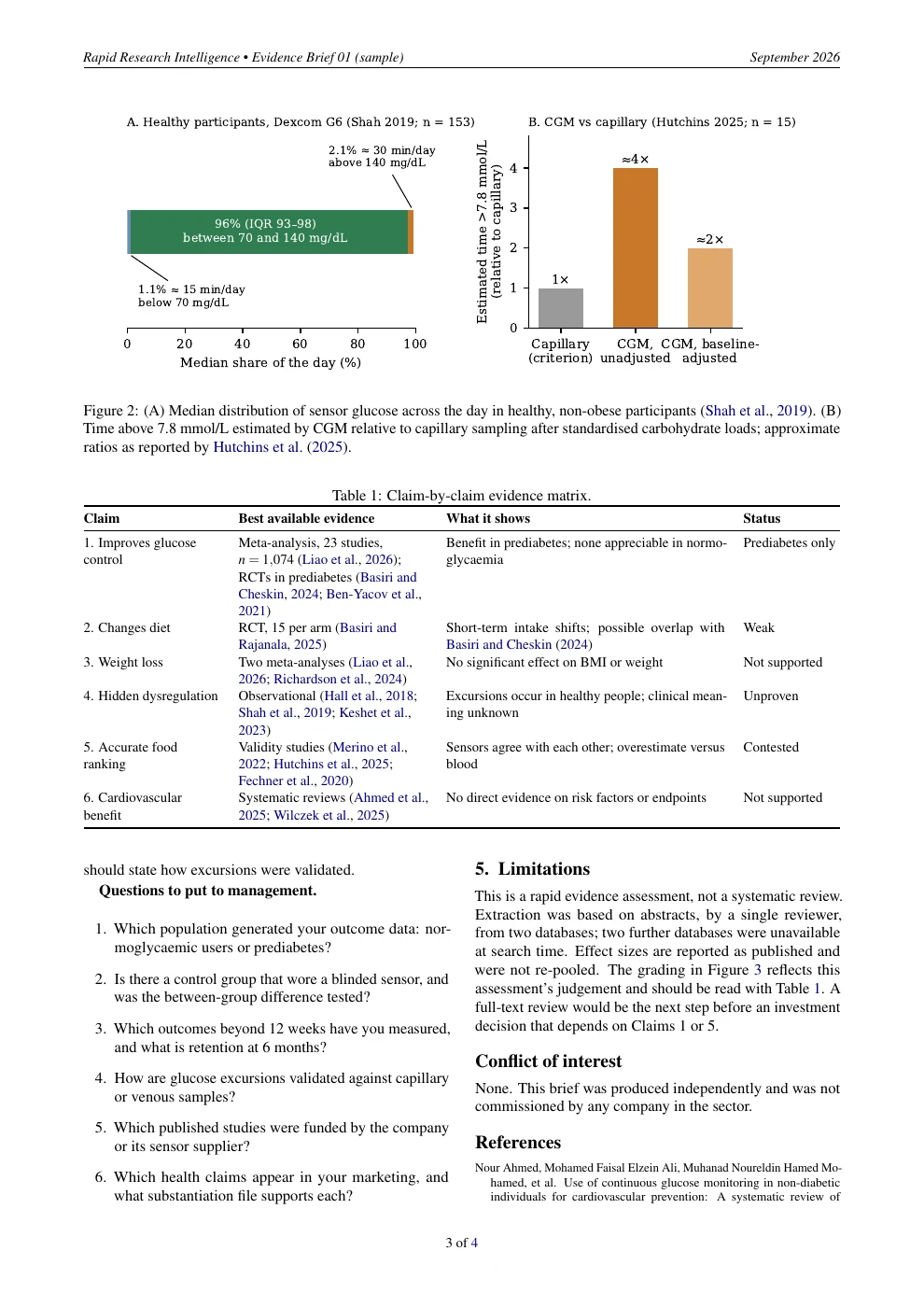
This sample examines six commercial claims about continuous glucose monitoring in people without diabetes. It shows how I turn a literature search into a brief an investment team can interrogate.
- A claim-by-claim assessment of the available evidence.
- Study limitations, conflicting findings and unresolved risks.
- Specific questions to put to management before a decision.
Free PDF · Four pages · No email required. Independently produced sample, not a client commission or a systematic review.
Can you trust an AI benchmark?
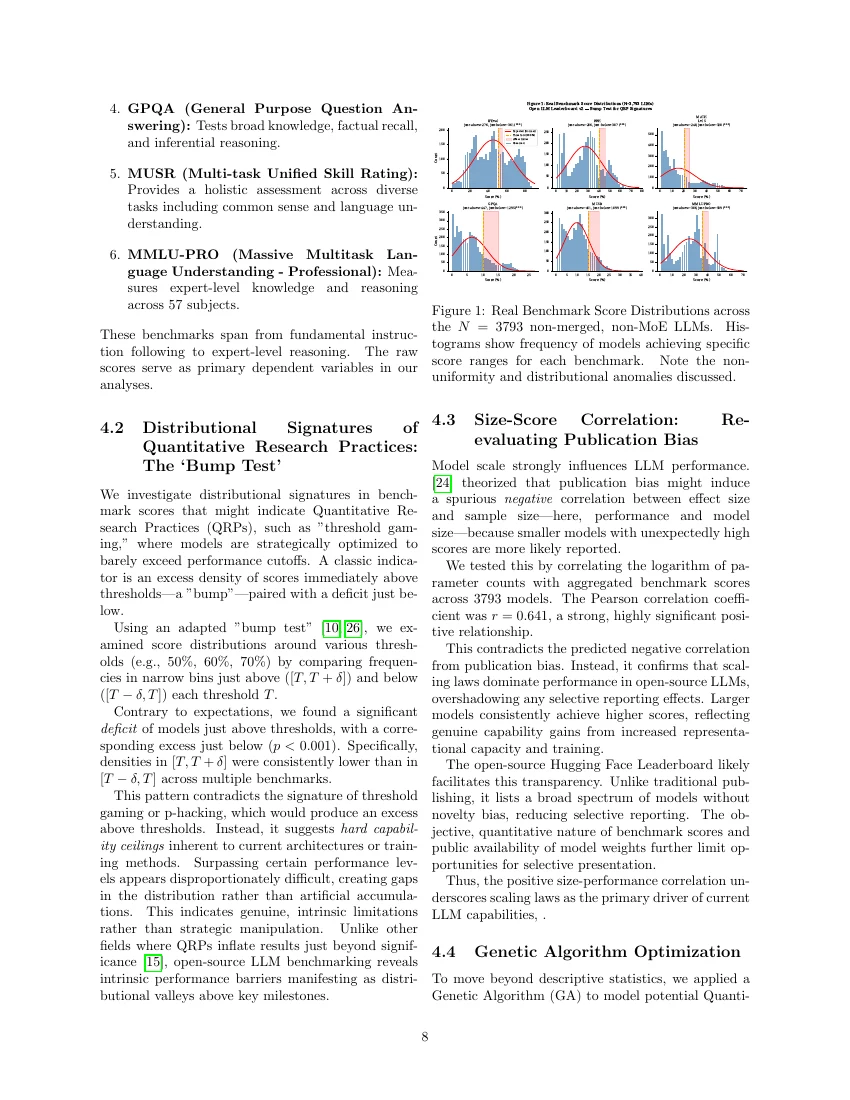
My original research examines 3,793 language models, six benchmarks and the role of questionable research practices. It investigates how evaluation choices and selective reporting can affect the results you see on a leaderboard.
Read the benchmarking paper (PDF)For my peer-reviewed work on research methods, see the publications.
BEFORE YOU COMMISSION THE WORK
A few practical questions.
How is a rapid evidence review different from a literature review?
A rapid synthesis is organised around a concrete, time-sensitive decision and deliberately limited coverage. A literature review may need a broader map of a field or deeper comparison of studies. We choose the method from the question and intended use, not the label.
Can you guarantee an answer in 48–72 hours?
That is the normal window for standard scoped work once inputs and allocation are confirmed, not a blanket guarantee. I confirm the delivery window before you commission the brief and flag work that needs a longer schedule.
Can the review use our internal documents?
Yes, subject to agreed access, confidentiality and scope. Describe sensitive material in general terms in the enquiry; we arrange document sharing separately. Client datasets and messy internal material start at a larger allocation under the published offer.
What if the evidence does not support our preferred option?
The brief says so and shows why. You are commissioning an evidence review consultant to test the question, not to manufacture support for a predetermined conclusion.
Read the full commercial offer for package allocations, confidentiality and payment terms.
START WITH THE DECISION
Scope my evidence brief
A short brief is enough to start. I’ll review whether the question fits, then confirm scope, price, deliverable and timing with you before work begins.
No purchase or commitment at this stage. Please describe sensitive material in general terms; we can arrange confidential sharing separately.
Focused assignments from €595.
Sprint budget: €3,500 / 10 RE.
Excluding VAT. Package allocations may span several delivery cycles.